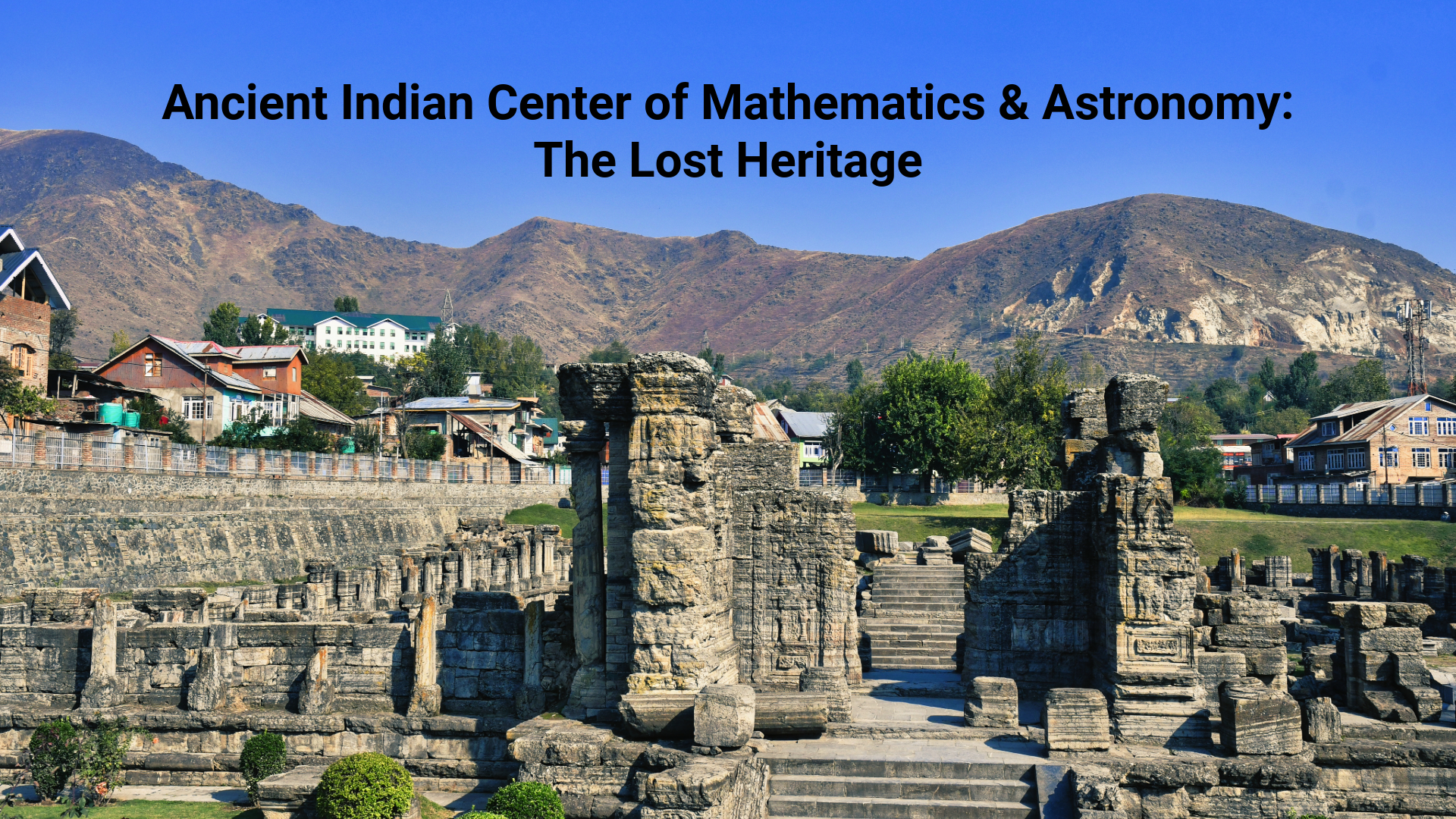
Kashmir: the panoramic valley that once echoed with the sound of scholars. Sharada Peeth, the Bakhshali manuscript & ancient Kashmiri dynasties made it India’s mathematical heartbeat. Between the 5th and 12th centuries CE, Kashmir nurtured a dense network of monasteries, libraries, scholars, royal patrons, and travelling intellectuals. Moreover, it produced and preserved some of the most significant Indian mathematical contributions, from early arithmetic and algebraic rules to advanced astronomical treatises.
When Kashmir Spoke the Language of knowledge and Numbers, Not Conflict
When people talk about Kashmir today, the conversations usually revolve around politics, borders, security, and a conflict-scarred identity.
But imagine, for just a moment, a different Kashmir. A Kashmir where the most powerful debates were not about land, but about algebra. Where travellers from Gandhara, China, and Tibet came not to conquer, but to learn Indian mathematics and astronomy.
Further, a place where kings built not armies, but universities. Where manuscripts, not weapons, were treasured.This is not fiction. This is the real, forgotten history of Kashmir.
Between the 6th and 12th centuries CE, Kashmir was one of Asia’s most advanced mathematical and intellectual centers, home to:
- Sharada Peeth, a world-renowned university, dedicated to the goddess Sharada (Saraswati), deity of learning
- The Bakhshali Manuscript, containing the earliest known zero
- The mathematician Vateswara and his astronomical Vateswara-siddhanta
- The scholar-friendly Karkota dynasty and Utpala dynasty
This article reopens the gates of a silent, snow-capped valley that once hummed with ideas, innovation, and scientific brilliance.
Let’s journey into that intellectual Kashmir.
1. Kashmir: More Than a Beautiful Valley—A Himalayan Harvard of the Ancient World
Unlike the Kashmir we know today, ancient Kashmir was an intellectual superhighway. Caravans crossing the Silk Route brought scholars, astronomers, traders, monks, and manuscripts.
Additionally, Kashmir’s setting, isolated yet connected, created the perfect ecosystem for advanced scientific exploration:
- Calm monasteries → ideal for mathematical study
- High-altitude clear skies → perfect for astronomical observation
- Royal patronage → stable environment for scholarship
- Multicultural interactions → constant inflow of ideas
This combination transformed Kashmir into a powerful centre of knowledge, rivaling ancient universities like Nalanda.
2. Sharada Peeth: The Temple-University That Lit Up Asia

Long before modern campuses existed, the world honored Sharada Peeth as one of its greatest learning centers, often compared to Takshashila. Located near the Kishenganga River in present Pak-occupied-Kashmir, Sharada Peeth emerged around the 6th century CE.
Why Sharada Peeth Was Extraordinary
- It was both a temple and a university
- It held vast libraries with texts on mathematics, astronomy, grammar, and metaphysics
- It developed and preserved the Sharada script, crucial for scientific writing
- Scholars from Tibet, China, Central Asia, and India travelled here to study
Sharada Peeth wasn’t just a seat of philosophy, it was a laboratory of numbers, where astronomical charts, Siddhntas, and geometry manuals were copied, studied, and refined. Grdually, Kashmir’s mathematical tradition radiated outside the Indian subcontinent from this intellectual nucleus.
3. The Bakhshali Manuscript: Where Zero Was Born

Unearthed in 1881 near present-day Pakistan but written in a Kashmir-linked script, the Bakhshali Manuscript is one of humanity’s most important scientific documents.
What Makes It Revolutionary?
- Contains the earliest known written use of zero (as a dot)
- Provides rules for arithmetic, algebra, and geometry
- Offers sophisticated square-root approximations
- Features real-life commercial math problems
This manuscript proves that mathematics in the greater Kashmir region was far ahead of its time. It wasn’t just theoretical, it was practical, applied, and used in trade, architecture, and astronomy.
4. Vateswara: The Indian Mathematician Who Mapped the Skies
In the 10th century, Kashmir gave the world one of its most accomplished astronomer-mathematicians: Vateswara.
His Masterpiece: The Vateswara-siddhanta
This astronomical treatise showcases:
- refined trigonometric tables
- interpolation techniques
- planetary motion models
- eclipse prediction methods
- algebraic solutions to astronomical problems
Vateswara built upon the great Indian astronomer Aryabhata’s legacy, yet brought a distinct Kashmiri precision, a blend of mountain sky observation and scholarly rigor.
His work influenced generations of astronomers across North India.
5. The Karkota & Utpala Dynasties: Kings Who Built an Indian Kingdom of Knowledge

While ideas fuel scholarship, patronage sustains it. Consquenly, Kashmir’s golden age of mathematics coincided with the visionary rule of the Karkota and Utpala dynasties.
The Karkota Dynasty (625–885 CE)
Under rulers like Lalitaditya Muktapida:
- universities flourished
- manuscript copying centers expanded
- astronomical observatories were funded
- international scholars were invited
This period likely saw the compilation of key Kashmiri siddhāntas and mathematical texts.
The Utpala Dynasty (855–1015 CE)
Under kings like Avantivarman:
- irrigation and canal systems were engineered using advanced mathematics
- Vateswara and other astronomers thrived
- architectural projects demanded precision geometry
Here, mathematics became a tool of statecraft, shaping everything from agriculture to temple construction.
6. How Kashmir Became a Mathematical Powerhouse
Kashmir’s rise as a scientific learning center was no accident, it came from a powerful blend of:
Royal patronage
Evolution of strong writing traditions (Sharada script)
A cosmopolitan scholarly network
Deep connection between ritual, cosmology & mathematics
High-altitude conditions ideal for astronomy
This mix created an Indian intellectual region where mathematics was not just studied, it was lived.
7. The Decline: How this Indian Valley of Knowledge Fell Silent
By the 12th century, political instability, invasions, and the decline of monasteries led to:
- dispersal of scholars
- disappearance of libraries
- loss of Sharada Peeth’s academic role
What survived were only fragments, manuscripts in Nepal, Tibet, and European archives.
Yet the legacy remained etched in stone, script, and sky.
Conclusion — Reviving the Intellectual Kashmir We Forgot
Today, when Kashmir is mentioned, few imagine a land where astronomers watched the heavens, mathematicians refined zero, and scholars debated algebra beneath cedar trees.
But that Kashmir was real. Sharada Peeth was real. Vateswara was real. The Bakhshali Manuscript was real. The dynasties that nurtured brilliance were real. And so is the legacy.
As we rediscover India’s glorious past, Kashmir must reclaim its rightful place not just as a valley of beauty, but as a valley of genius.


Leave a Reply