From the lush tea gardens of Darjeeling to the saline winds of the Sunderbans, West Bengal is more than a state—it is a political theatre where the stakes are always existential. As the 2026 Assembly Elections reach their crescendo, the air is thick with the scent of shorshe ilish (mustard fish) and the sound of fierce parar addas (neighborhood debates). This is an editorial journey through the history, demography, and the high-octane drama of the Bengal polls.
A: The Agendas of Today
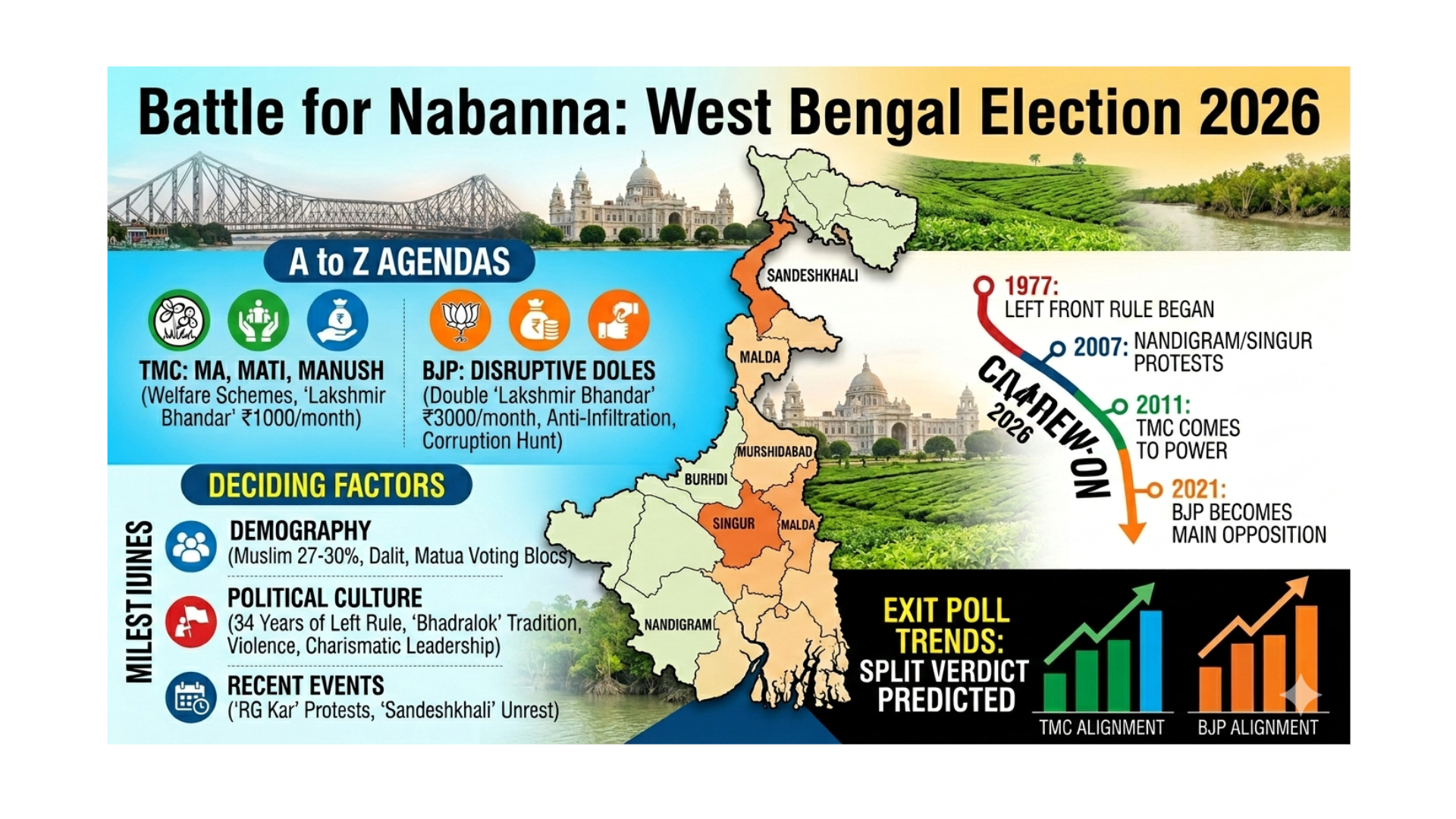
The 2026 battle is a clash of two distinct visions. On one hand, the ruling Trinamool Congress (TMC) relies on its “Ma, Mati, Manush” (Mother, Land, People) philosophy, anchored by robust welfare schemes like Lakshmir Bhandar (cash transfers for women). On the other, the BJP has unleashed a manifesto of “Disruptive Doles”—promising to double those cash transfers to ₹3,000 and pitching a “Zero Tolerance” policy toward infiltration and corruption.
B: Bhadralok and the Political Culture
Bengal’s political culture is unique; it’s a land where pictures of Marx and Mao once sat next to Tagore. The Bhadralok (the educated middle class) once dictated the narrative, but today, politics has shifted to the grassroots. It is visceral, often violent, and deeply personal. In Bengal, you don’t just vote; you “belong” to a party.
C: Communism’s Long Shadow
For 34 years (1977–2011), the Left Front, led by the legendary Jyoti Basu, held an iron grip. They transformed the rural landscape with Operation Barga (land reforms), but eventually, the “Red Fort” crumbled under the weight of industrial stagnation and the ghosts of Singur and Nandigram.
D: Demography is Destiny
Bengal’s map is a demographic jigsaw. With a Muslim population of roughly 27–30%, and significant Dalit and Matua communities, every move is a calculation. The 2026 election has seen a controversial “SIR voter deletion” exercise, where millions of names were purged from rolls, sparking allegations of demographic engineering that could tilt the balance in districts like Malda and Murshidabad.
E: Exit Polls and the “Edge”
As the dust settles on the final phases, exit polls are split. Some predict a historic breakthrough for the BJP, placing them above the 148-seat majority mark, while others suggest Mamata Banerjee’s “Fortress Bengal” remains impenetrable. The suspense is a silent storm.
The Milestones: A Story of Shifts
- 1977: The Red Dawn. After the chaos of the Naxalbari movement and the Emergency, the Left Front surged to power. It was the birth of the longest-serving democratically elected communist government in the world.
- 2007: The Turning Point. The soil of Nandigram and Singur became the graveyard of the Left. Protests against Tata Motors’ Nano plant and land acquisition for a SEZ turned violent. A fiery leader in a white cotton saree and flip-flops, Mamata Banerjee, seized the moment.
- 2011: Paribartan (Change). The “Didi” era began. Mamata Banerjee ended 34 years of Marxist rule, promising a “New Bengal.”
- 2019–2021: The Saffron Surge. The BJP, previously a marginal player, jumped from 3 seats to 77 in the Assembly, positioning itself as the primary challenger and turning the state into a bipolar battlefield.
F: Factors of the Present: “Sandeshkhali” to “RG Kar”
Recent events have added layers of complexity. The Sandeshkhali unrest over local strongmen and the tragic RG Kar Medical College case have fueled an opposition narrative of “lawlessness.” Meanwhile, the TMC counters with “Central Agency Vendetta,” claiming the ED and CBI are being used to dismantle the state’s executive.
G: The “Didi” Factor
At the heart of it all is Mamata Banerjee. To her supporters, she is the lone warrior against the “outsider” (Bohiragoto) forces of Delhi. To her critics, she represents a party plagued by “syndicate culture.” Her personal charisma remains the TMC’s greatest asset and its primary shield.
Z: The Zero Hour
As the counting day approaches, Bengal stands at a crossroads. Will it choose the continuity of the Trinamool’s welfare state, or will it embrace the BJP’s promise of Sonar Bangla (Golden Bengal)? In this state, history isn’t just remembered; it is rewritten at every polling booth.

Leave a Reply