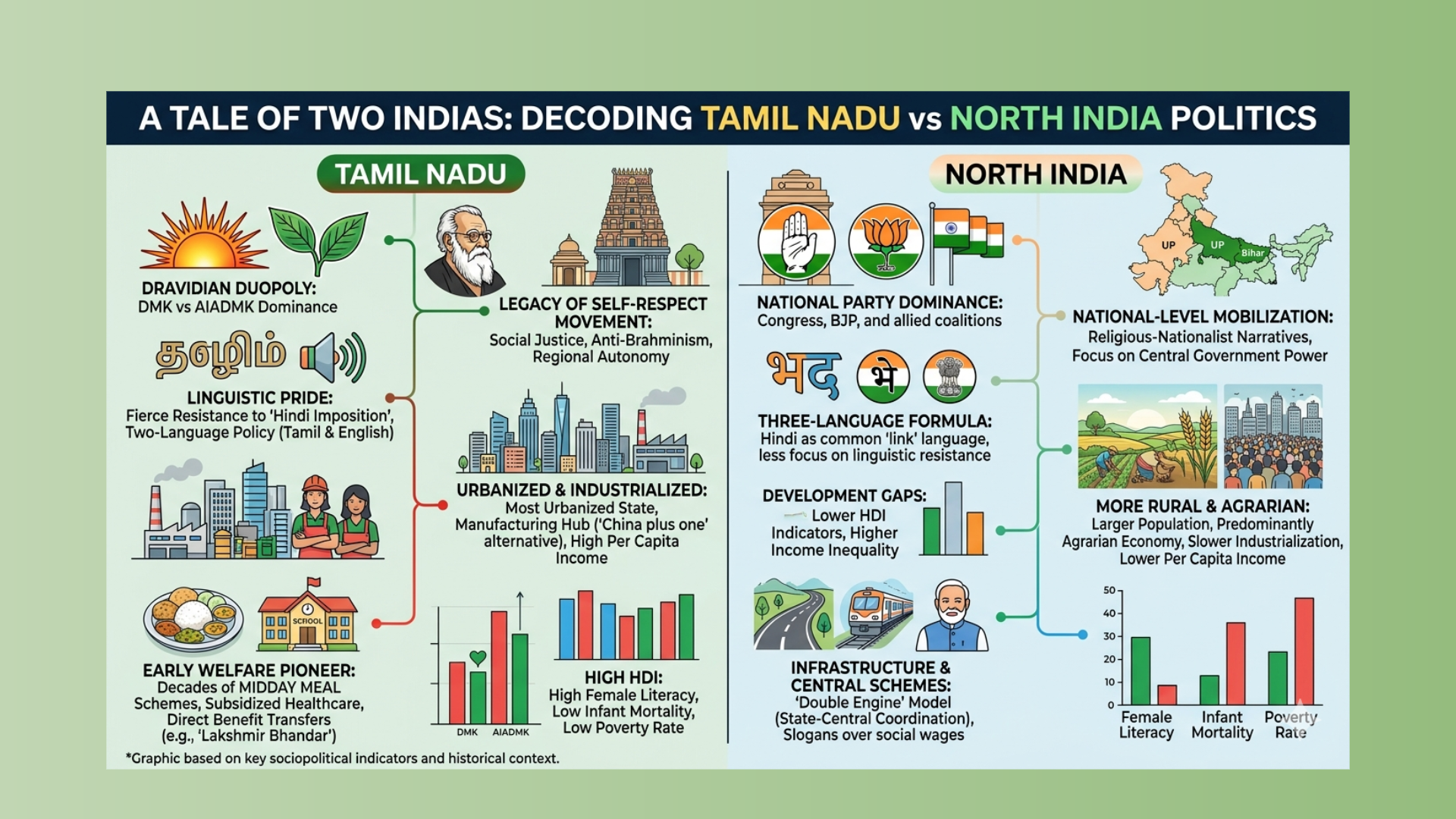
The political and social fabric of Tamil Nadu stands in stark contrast to that of North India, rooted in a nearly century-old movement that prioritized regional identity, social reform, and economic self-reliance. While North Indian politics often revolves around national parties and religious-nationalist narratives, Tamil Nadu remains a fortress of “Dravidianism”—an ideology that has successfully resisted centralizing forces for decades.
The following factors define the fundamental differences between Tamil Nadu and the North:
1. The Dravidian Movement and Anti-Brahminism
Unlike the North, where the caste system often defines political blocks within a broader Hindu identity, Tamil Nadu’s politics was forged in anti-Brahminism and the Self-Respect Movement.
- Periyar’s Legacy: Founded by E.V. Ramasamy (Periyar), the movement rejected Brahminical hegemony and sought to end the social and economic domination of North Indian influences.
- Rationalism over Religion: While religious identity is a potent mobilizing force in North India, Dravidian parties historically championed rationalism and atheistic leanings, focusing on social equality rather than religious orthodoxy.
2. Linguistic Pride and the Anti-Hindi Stance
For many in Tamil Nadu, language is not just a medium of communication but a core component of nationalist identity.
- Resistance to Hindi: Since the 1930s, the state has fiercely resisted the “imposition” of Hindi, viewing it as a tool of North Indian cultural colonialism.
- Two-Language Policy: While North Indian states typically follow a three-language formula (Hindi, English, and a regional language), Tamil Nadu strictly adheres to a two-language policy—Tamil and English—to ensure global competitiveness while protecting linguistic pride.
3. The “Welfare State” vs. National Schemes
Tamil Nadu pioneered a model of social welfare that preceded many national programs by decades.
- Early Implementation: Long before national mandates, Tamil Nadu implemented midday meal schemes, extensive reservation for backward classes, and targeted healthcare for women and children.
- Decentralized Success: The state’s welfare model is deeply embedded in its administrative capacity, leading to human development indicators (like female literacy and infant mortality) that far outperform large North Indian states like Uttar Pradesh and Bihar.
4. Economic and Industrial Divergence
The economic gap between the two regions has widened significantly since the 1960s.
- Per Capita Income: By 2021, the average annual per capita income in southern states, including Tamil Nadu, was nearly 250% higher than in key northern states.
- Industrialization: Tamil Nadu is the most industrialized state in India, with a diverse economy spanning automobiles, textiles, and electronics. It is nearly 48% urbanized, whereas many North Indian states remain predominantly rural and agrarian.
5. Regional Duopoly vs. National Parties
Since 1967, national parties like the Indian National Congress and the BJP have been largely sidelined in Tamil Nadu. The state is ruled by a regional duopoly (DMK and AIADMK) that prioritizes state autonomy. In contrast, North Indian states are frequently the main battlegrounds for national power, with local regional parties often eventually aligning with larger national coalitions.


Leave a Reply