Introduction
The concept of federalism in India is not just a constitutional arrangement but also a socio-political value — balancing unity with diversity, decentralization with central coordination. The grand celebration of Rashtriya Ekta Diwas (National Unity Day on 31 October, the birth anniversary of Sardar Patel) makes this context especially evident. The celebration reaffirms national integration, state-centered cooperation, and the idea that despite diverse languages, cultures, and regional interests, India stands united.
Sardar Patel’s vision of federal unity
Sardar Vallabhbhai Patel was a key architect of India’s national integration after independence. He negotiated with more than 550 princely states to join the Indian Union, helping to unify fragmented lands into a united, sovereign nation.
- He believed in building strong administrative institutions. The Indian Administrative Service (IAS) and Indian Police Service (IPS) were considered part of the “steel frame” that could hold the Union together.
- His approach was pragmatic, emphasizing persuasion, diplomacy, and institutional design over coercion. This set the foundation for a federal system that respects regional diversity but ensures national integrity.
- Patel’s vision also included cultural and administrative unity: linking regions through governance and shared values, ensuring that diversity does not become a source of fragmentation.
Building ‘Ek Bharat Shreshtha Bharat: Modi Government’s Federal Vision

Under Prime Minister Narendra Modi, India’s federal framework has been redefined through a balanced blend of cooperative and competitive federalism, which echoes the spirit of “Ek Bharat Shreshtha Bharat” and aspires to realize the vision of a “Viksit Bharat” by 2047.
Cooperative federalism: The idea is that the Centre and states should collaborate rather than being merely donor/recipient. For example, the creation of the NITI Aayog (established in 2015) replaced top-down planning with a mechanism for states to engage in policy formulation, set priorities, and execute with flexibility.
Competitive dimension: States are encouraged to compete in development metrics (infrastructure, social indicators, economic growth). This competition aims to push states to innovate, raise governance quality, and adopt best practices.
Centre as facilitator: Drawing on his experience as a former Chief Minister, PM Modi envisions the Centre as a facilitator, not a controller, helping states overcome challenges through coordination platforms like the Inter-State Council and Zonal Councils under the “Team India” spirit.
Narrative alignment with Patel: The government often cites Patel as a symbol of integration and unity. On the 150th birth anniversary, PM Modi said that “this is the India of the Iron Man … it will never compromise on its security or its self-respect.”
PM Modi wrote in a post on “X”: “India pays homage to Sardar Vallabhbhai Patel on his 150th Jayanti. He was the driving force behind India’s integration, thus shaping our nation’s destiny in its formative years. His unwavering commitment to national integrity, good governance, and public service continues to inspire generations.”
Ekta Diwas: reaffirming the unity message

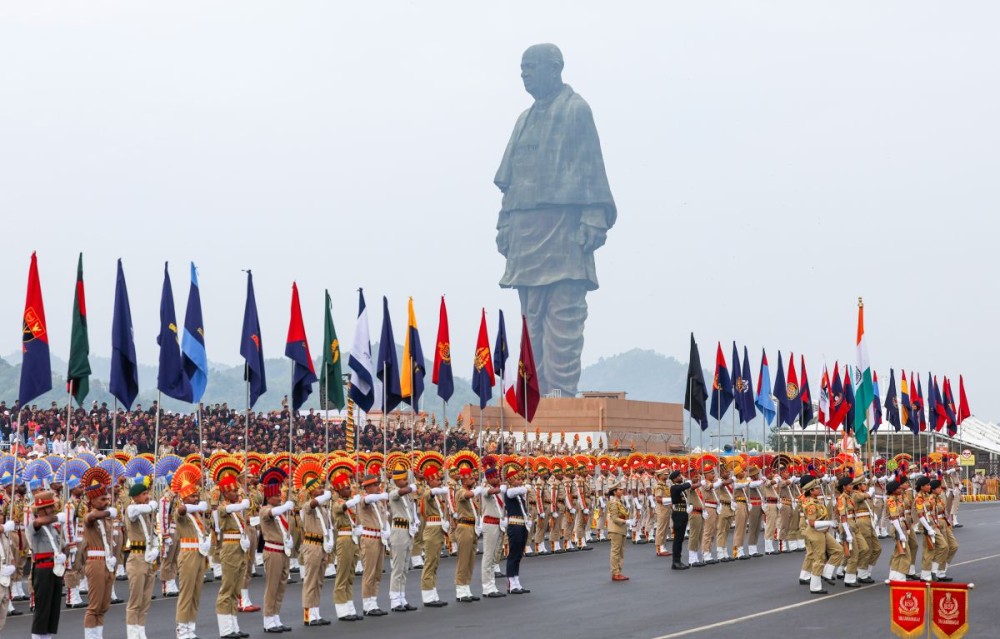
On Ekta Diwas, a pledge is administered across government offices and institutions to reaffirm commitment to national unity and avoid actions that weaken national integrity.
Ceremonies include parades involving central forces (e.g., central armed police, state police contingents), cultural tableaux representing “Unity in Diversity.”
The day also invokes Patel’s legacy explicitly: his integration work is celebrated, and events highlight cultural bonds across states.
This provides a symbolic anchor for the federal-unity narrative: the states are not just administrative divisions but integral parts of one India bound in a shared destiny.
Conclusion: The Iron Man’s Vision Lives On
The legacy of Sardar Patel remains central to India’s idea of federalism: unity without erasing diversity, institutional strength alongside local autonomy. Under the Modi government, this legacy is invoked often — not only symbolically on Ekta Diwas, but also through institutional reforms and policy frameworks that emphasize cooperative and competitive federalism.
Ekta Diwas becomes more than a commemorative event: it is a ritual reaffirmation of the political ideals of integration, shared purpose among states, and national integrity.

Leave a Reply