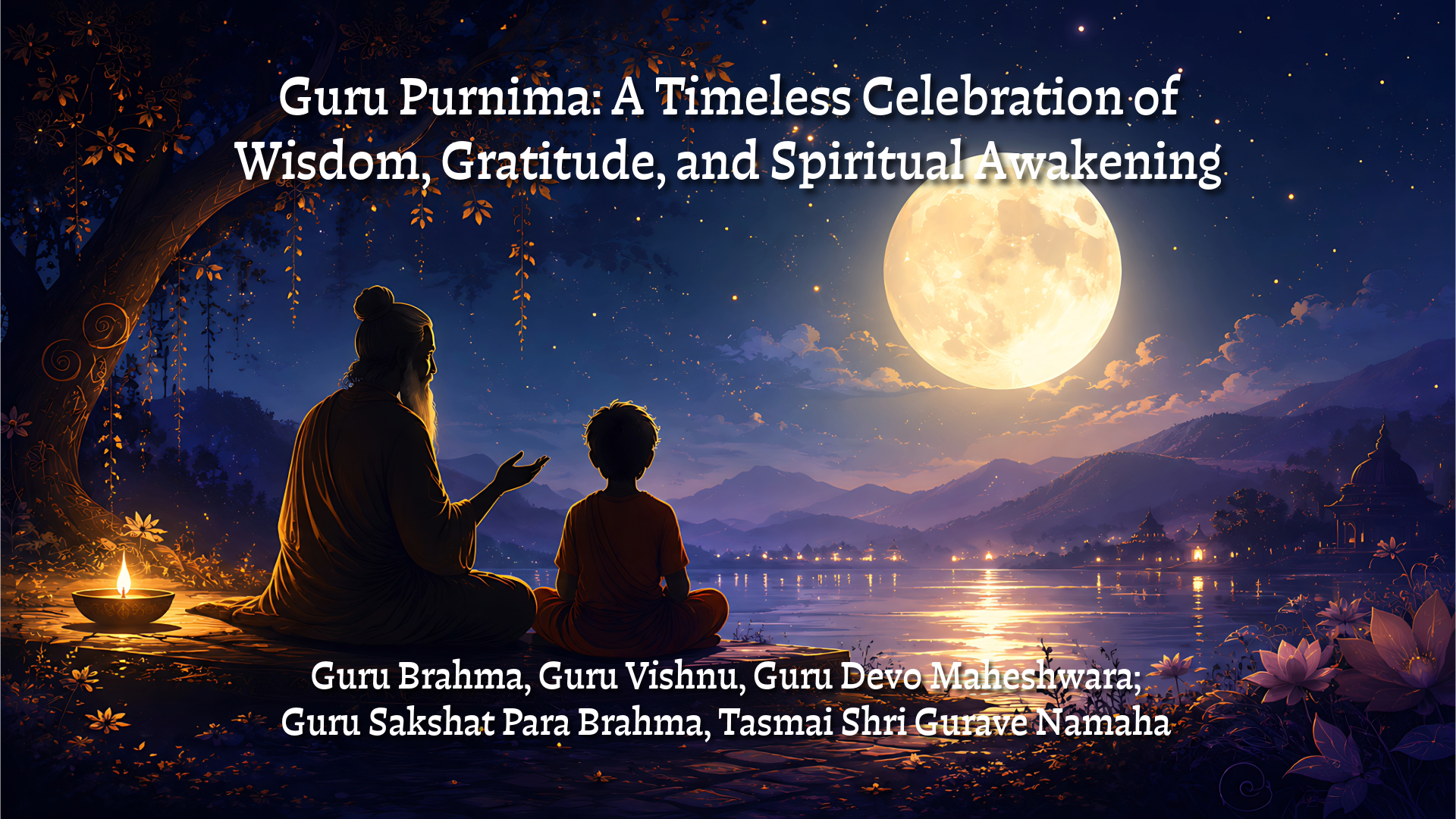
In the vast tapestry of Eastern traditions, knowledge is not regarded merely as information gathered from books—it is celebrated as an illuminating flame that dispels the deepest shadows of human existence. At the heart of this ancient wisdom lies the sacred relationship between the seeker and the guide, the disciple and the master. Guru Purnima is the grand, timeless tribute to this eternal bond.
The word Guru is derived from two Sanskrit roots: Gu, meaning “darkness” or “ignorance,” and Ru, meaning “that which dispels”. A Guru is not merely an academic instructor or a formal teacher; a Guru is the living catalyst who awakens the dormant divinity within a disciple, transmuting raw potential into self-realization. Celebrated on the full moon day (Purnima) of the Hindu lunar month of Ashadha (June–July), Guru Purnima transcends boundaries of geography and creed. It is a moment of profound gratitude, self-introspection, and spiritual realignment.
Historical Aspects: The Legacy of Reverence Across Eras and Communities
Tracing the Ancestral Footprints of Sacred Gratitude
The practice of honoring the mentor on the Ashadha Purnima is as old as Indian civilization itself. Historically, Guru Purnima marked the onset of the Varsha Ritu (monsoon season). In ancient India, wandering monks, ascetics, and sages usually traveled on foot throughout the year to spread wisdom. They used to pause their journeys for four months during the heavy rains. This four-month retreat, known as Chaturmas, began on Guru Purnima. Sages and their disciples would settle in ashrams, caves, or monasteries to engage in deep study, meditation, and spiritual discourses.
Communities Observing Guru Purnima and Their Traditions
Over millennia, Guru Purnima has evolved into an inclusive, multi-faith celebration observed by diverse spiritual communities across the Indian subcontinent and the global diaspora:
- Hindus: Observe the day as Vyasa Purnima. They pay homage to Maharishi Ved Vyasa, the architect of classical Indian literature. People also honor their personal spiritual gurus (Diksha and Shiksha Gurus).
- Buddhists: Reverently celebrate the day as Esala Poya. It marks the moment Lord Buddha delivered his first sermon at Sarnath, founding the Dharmachakra (Wheel of Dharma).
- Jains: Commemorate the day as the occasion when Lord Mahavira made Indrabhuti Gautama his first chief disciple (Ganadhara). It officially initiated the Jain monastic order.
- Sikhs: Sikhs revere the ten human Gurus and the Sri Guru Granth Sahib throughout the year. But the ethos of Guru Purnima aligns deeply with the foundational Sikh doctrine of absolute devotion to the Divine Teacher.
- Classical Performing Artists and Scholars: Dancers, musicians, and traditional scholars hold sacred ceremonies (Guru-Shishya Parampara) to seek blessings from their mentors and seek mastery over their art.
Spiritual Significance: Why We Observe Guru Purnima and What Is Gained
Unlocking the Inner Alchemy of Transformation
The full moon (Purnima) represents completeness, illumination, and peak energy. Just as the full moon reflects the full light of the sun without obstruction, a disciple on Guru Purnima strives to make their mind a clear mirror, reflecting the pure wisdom of the Guru.
“Guru Brahma, Guru Vishnu, Guru Devo Maheshwara;
Guru Sakshat Para Brahma, Tasmai Shri Gurave Namaha.”
(The Guru is the Creator, the Sustainer, and the Transformer; the Guru is the Supreme Reality manifest before us. To that noble Guru, I bow.)
What a Seeker Gains on Guru Purnima
- Dissolution of Ego (Ahamkara): The primary barrier to spiritual enlightenment is the inflated sense of self. Surrendering at the feet of a Guru on this day is a symbolic act of laying down one’s pride, opening the heart to receive grace.
- Re-ignition of Spiritual Vows: For practitioners of yoga, meditation, and self-inquiry, Guru Purnima acts as an annual spiritual check-in. It is a day to recommit to self-discipline, sacred chants (Mantras), and self-study (Svadhyaya).
- Transmission of Subtle Grace: In Yogic traditions, it is believed that on Guru Purnima, the subtle channels (Nadis) of the human body are exceptionally responsive. The spiritual transmission (Shaktipat) or subtle blessings from a master yield magnified spiritual progress.
- Cultivation of Gratitude: Gratitude (Kritagyata) is a powerful emotional frequency that elevates psychological well-being. Honoring one’s teachers instills humility, mental calm, and emotional resilience.
Mythological Stories: Divine Narratives Behind the Celebration
Chronicles of Sages, Gods, and Enlightened Masters
The sacredness of Guru Purnima is enriched by several legendary events embedded in ancient scriptures.
Story 1: The Nativity and Works of Maharishi Ved Vyasa
The most prominent Hindu narrative centers around Maharishi Ved Vyasa, born to Sage Parashara and Satyavati on Ashadha Purnima. Sage Vyasa is regarded as an incarnation (Avesha Avatara) of Lord Vishnu, specifically tasked with organizing spiritual knowledge for the age of Kali Yuga.
Before Vyasa, the sacred Vedic knowledge existed as a vast, monolithic body of oral tradition. Realizing that future generations would lack the memory power to preserve it intact, Vyasa compiled and divided the single Veda into four distinct Samhitas: Rigveda, Yajurveda, Samaveda, and Atharvaveda. Additionally, he authored the 18 Mahapuranas, the Brahma Sutras, and the immortal epic Mahabharata (which contains the Bhagavad Gita). Because of his monumental contributions to human thought, Guru Purnima is also revered as Vyasa Purnima, and Vyasa is honored as the Prathama Guru (the original teacher of humanity).
Story 2: Lord Shiva Becomes the Adi Guru (The First Yogi)

According to Yogic tradition, over fifteen thousand years ago, a Yogi appeared in the upper regions of the Himalayas. He showed no signs of life except for tears of ecstasy rolling down his face. People gathered, expecting miracles, but he remained motionless in deep absorption (Samadhi) for weeks. Eventually, all left except seven dedicated seekers, the Saptarshis (Seven Sages).
The seven seekers pleaded with him to share his state of being. The Yogi ignored them at first. But seeing their unwavering commitment over 84 years of intense preparation (Sadhana), he finally relented. On the full moon day of Ashadha, as the sun began its southward movement (Dakshinayana), the Yogi sat facing south and turned himself into the Adi Guru (the First Teacher). He transmitted the 112 fundamental methods of physical and spiritual transformation to the Saptarshis. Thus, the science of Yoga was born on Guru Purnima.
Story 3: Gautama Buddha’s First Sermon at Sarnath

For five long years after attaining enlightenment under the Bodhi tree in Bodh Gaya, Gautama Buddha remained silent. He then traveled to Deer Park in Sarnath, near Varanasi. There, on the full moon night of Ashadha, he met five of his former ascetic companions.
Recognizing the radiant transformation in him, they bowed down and requested his guidance. Lord Buddha delivered his inaugural discourse, the Dhammacakkappavattana Sutta (Setting in Motion the Wheel of the Dhamma). It explains the Four Noble Truths and the Eightfold Path. This momentous event established the Buddhist Sangha (spiritual community) and marked Ashadha Purnima as a sacred day in Buddhist history.
Dos and Don’ts on Guru Purnima: Sacred Rules for Divine Grace
Navigating the Day with Purity, Mindfulness, and Respect
To maximize the spiritual and mental benefits of Guru Purnima, traditional texts recommend following specific guidelines (Vidhi) while avoiding actions that bring negative Karma.
The Recommended Practices (Dos)
- Perform Guru Padapuja or Offer Gratitude: If your physical Guru is accessible, seek their blessings by washing their feet (Padapuja) or offering flowers, fresh fruits, and a Dakshina (respectful offering). If your Guru is no longer in physical form or far away, meditate upon their image or light a lamp in front of their photograph.
- Honoring Parents as First Teachers: Hindu scriptures declare Matru Devo Bhava, Pitru Devo Bhava (Mother is God, Father is God). Express heartfelt gratitude to your parents on this day.
- Chant Spiritual Mantras: Recite the sacred Guru Mantra or the Jupiter/Brihaspati Mantra 108 times to invite wisdom and mental clarity.
Om Gram Greem Groum Sah Gurave Namah
ॐ ग्रां ग्रीं ग्रौं सः गुरवे नम
- Engage in Charitable Giving (Daan): Donate educational materials (books, notebooks, pens) to underprivileged students. You can also offer yellow food items (such as Chana Dal, bananas, turmeric, or yellow sweets) to spiritual seekers and monks.
Practices to Avoid (Don’ts)
- Avoid Disrespecting Teachers or Knowledge: Refrain from criticizing, insulting, or speaking ill of any teacher, mentor, or guide—past or present.
- Avoid Tamasic Food and Mindsets: Steer clear of non-vegetarian food, alcohol, and heavy, stale meals. Keep the digestive system light so energy can flow easily during spiritual practices.
- Avoid Arrogance and Pride: Guru Purnima is basically a lesson in humility. Avoid bragging about your achievements or making charitable donations to show off.
- Avoid Quarrels and Negative Speech: Guard your tongue against gossip, harsh criticism, and useless arguments.
When It Falls: Astrological Timing and Calendar Dates
Understanding the Cosmic Clockwork of Ashadha Purnima
The timing of Guru Purnima is governed by the ancient Vedic Panchang (lunar-solar calendar). Unlike the Gregorian calendar, which relies strictly on solar years, Hindu festivals follow the movement of the Moon (Tithi).
Guru Purnima occurs precisely during Ashadha Shukla Purnima, the full moon day in the bright fortnight of the month of Ashadha. Astrologically, during this period, the Sun resides in the zodiac sign of Gemini or Cancer. And the Moon shines brightly in Sagittarius (Dhanu Rashi) or Capricorn (Makara Rashi). They generally remain in the nakshatras of Purva Ashadha or Uttara Ashadha.
Astrologically, the Guru is linked with the planet Jupiter (Brihaspati). This combination governs knowledge, higher learning, philosophy, and spiritual growth. Performing spiritual practices on this full moon balances Jupiter’s energy in one’s horoscope, enhancing wisdom, good judgment, and mental balance.
Guru Purnima Date in 2026
In 2026, Guru Purnima is on Wednesday, 29 July 2026.
Devotees are encouraged to perform prayers, Guru Puja, meditation, and charitable acts during the auspicious Purnima period.
Guru Purnima Date in 2027
In 2027, Guru Purnima will fall on Sunday, 18 July 2027.
As always, the exact puja timings may vary slightly depending on geographical location and local Panchang calculations.
Conclusion: Carrying the Torch of Wisdom Beyond the Full Moon
Guru Purnima is far more than an annual ritual or a nostalgic glance at ancient tradition; it is a vital, living reminder of our human capacity for growth, self-transformation, and gratitude. In an increasingly fast-paced, digital world where information is abundant but true wisdom remains rare, the role of a Guru—as a beacon of clarity, integrity, and unconditional guidance—is more relevant than ever.
Whether you look upon the Guru as a divine incarnation, a spiritual master, an academic teacher, or simply the inner voice of conscience, Ashadha Purnima invites us all to pause, bow our heads in humility, and honor those who light our path. As the full moon illuminates the night sky, may the timeless blessings of Maharishi Ved Vyasa and all spiritual masters awaken light, peace, and wisdom within every heart.


Leave a Reply