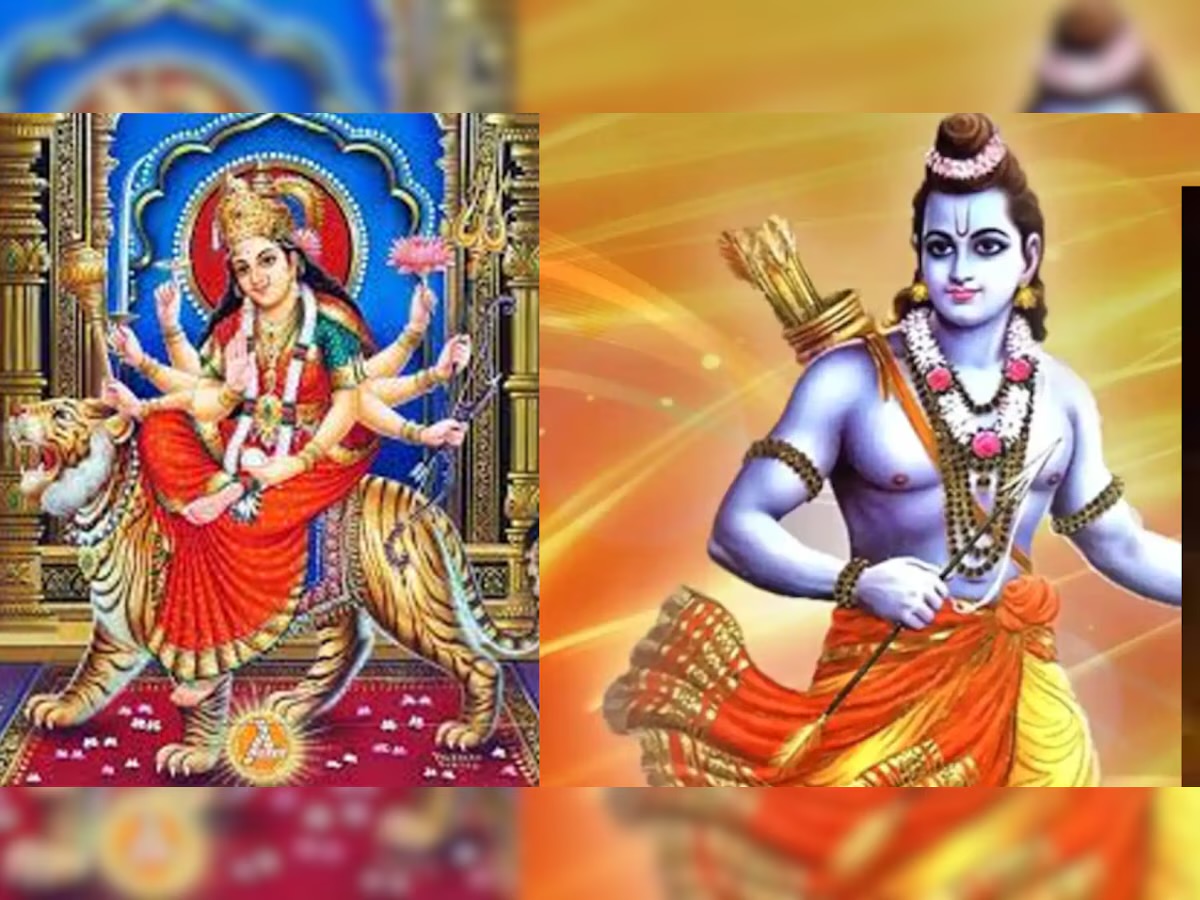
The Navratri festival is devoted to goddess Durga, whose nine forms are worshiped on nine days. The ninth day is also Rama Navami, the birthday of Lord Rama.
Ramnavami is an Indian spring festival, celebrating the birth of Lord Rama, the seventh avatar of Lord Vishnu. This festival marks the end of Vasanta Navratri. The festival falls on the month of Chaitra spreading 9 lunar days in the Hindu calendar.
In many regions, the festival falls after the spring harvest, and in others, during harvest. In the eastern parts of India, especially in Bengal, Assam, Manipur, Tripura, Orissa, Arunachal Pradesh & Jharkhand, the last three days of Navratri are marked as Basanti Puja.
The festival signifies the triumph of good over evil, light over darkness, and the power of the divine to protect the world. Let’s learn about the significance & rituals of all the 3 festivals.
Chaitra Navratri Significance & Rituals

The nine-day celebration of Chaitra Navratri is dedicated to Ma Durga. Devotees worship her nine incarnations during the nine days. It observes Goddess Durga’s giving birth to the universe & all living things in it. Devotees believe that Maa Durga shows up during Navratri and visits her devotees.
Similarly, numerous Hindu devotees dedicate this celebration to Lord Ram. They observe Ram Navami on the last day of Chaitra Navratri. It is believed that Lord Ram, the seventh avatar of Lord Vishnu was born during this time.
Chaitra Navratri: Pooja Ritual

Devotees observe Chaitra Navratri By worshiping goddess Durga and fasting for nine days. Each of the nine days is dedicated to a different incarnation of the Goddess. So each day has distinct rituals to perform. Devotees start the ceremony by placing a pot representing the Goddess, which is called ‘Ghatasthapana’.
One of the significant parts of Navratri is Kanya Puja done on day 8 of the festival. It is observed by praying young girls, who seem to represent the Goddess in a young form. The 9th day, known as Ram Navami, is observed as Lord Rama’s birthday. Devotees offer worship, sing Bhajans, and fast to earn his blessings.
Chaitra Navratri: Celebration
Chaitra Navratri is a festival to pray, meditate, fast, and enjoy a blissful time with friends and family. During the 9 days, devotees quit drinking alcohol, non-veg food, and tobacco.
They also avoid eating garlic and onion. Devotees worship Maa Durga and her nine incarnations, recite Durga mantras, and embellish their homes. Hindus believe that by practicing these customs they will earn blessings of Maa Durga.
The Significance of Basanti Puja

Basanti Puja, also known as Chaitra Durga Puja, is the original Puja of Goddess Durga. It is observed during the Chaitra Navratri, a 9-day celebration of worshiping nine different incarnations of Goddess Durga.
It is believed that Goddess Durga comes to stay with her devotees during this time, and so it Is considered to be an auspicious time. This puja is based on the belief that Durga Puja was originally held during the Spring season, or Basant, to observe the Spring equinox.
The Origin Of Basanti Puja
The mention of Basanti Puja can be found in the Markandeya Purana. It describes that King Surath worshiped Maa Durga in the month of Chaitra. Since then, Maa Durga was worshiped in the month of Chitra until Lord Rama worshiped Maa Durga in the month of Ashvin.
King Suratha lost his kingdom. To re-explore his fate, he left his capital, Bolipur (present-day Bolpur). He met a businessman, Vaishya Samadhi, who had a similar situation like Suratha. They met Sumedhas Muni, who after listening to their misfortunes, advised them to worship Devi Durga. Only the blessings of the Devi could help them regain their fortune. In the ashram of Sumedhas Muni, situated in the Garh Jungle of West Bengal, King Suratha and Vaishya Samadhi made a clay statue and worshiped Maa Durga. It is marked as the world’s first Durga Puja.
After performing Durga Puja, Vaishya regained his fortune, and Suratha got his kingdom back. He was able to retrieve all his lost property and returned gleefully to his capital, Bolipur. From then, he started worshiping the deity every year, during the spring, in present-day Bolepur.
It was Lord Ram, who changed the worship time of Goddess Durga from Chaitra to Ashwin (October – November). He had invoked Goddess Durga in Ashwin month to get her blessings before starting his campaign against the demon King Ravana in the Ramayana.
Significance Of Ram Navmi

Ram Navami symbolizes the eternal principles of Dharma (righteousness). It marks the victory of good over evil. Lord Rama’s life exemplifies the ideals of duty, honor, and sacrifice, inspiring devotees to uphold moral values and lead a life of righteousness.
Ram Navmi is a festival of unity, piety, and spiritual awakening among devotees. People get together with family and community to celebrate Ram Navami all together. They share joy, blessings, and goodwill. Ram Navami is a day of celebration of divine grace, righteousness, and the eternal victory of truth. It is perfect to remember Lord Ram and seek his blessing for peace, prosperity, and spiritual enlightenment.
On this day, special pujas and rituals are also performed, like Abhishekam (ceremonial bathing) of Lord Rama’s idol and offering him fruits and sweets. Devotees recite sacred mantras and pray to Lord Rama. In some places, people play Ram Lila. It is a performance where the famous scenes of Ramayana are recreated to entertain the audience.
Surya Tilak’ of Ram Lalla at Ayodhya Temple

On Ram Navmi 2024, the grand Ram Temple in Ayodhya witnessed a unique event as the forehead of the Ram Lalla idol was anointed with a ray of sunlight, known as ‘Surya Tilak’. A 5.8-centimeter beam of sunlight was made to fall on the deity’s forehead through cutting-edge scientific expertise involving mirrors and lenses.
A large number of devotees thronged Ayodhya’s Ram Temple on the occasion of Ram Navami in a vibrant display of faith and celebration. This is the first time Lord Ram’s devotees will celebrate his Janmotsav on the premises of the temple.
The Surya Tilak was performed for five minutes between 12 to 12:30 pm. Devotees were allowed to visit the temple during the Surya Tilak ceremony. It was the first Ram Navami since the consecration of the Ram idol at the new temple, inaugurated by Prime Minister Narendra Modi on January 22.
The Surya Tilak ceremony was broadcast on about a hundred large LED screens throughout Ayodhya. It was also live telecast on the social media accounts of the temple trust.


Leave a Reply